

Your customers have a lot to tell you.
But we still have to make them want to say them.
Today, a large portion of digital interactions take place via instant messaging. In France, 86% of people aged 12 and older used it in 2025, and 64% reported using it daily.
And in these conversations, voice messages have taken on a special role. According to a survey conducted by Preply, the French send or receive an average of 3.7 voice messages per day. Among Gen Z, that number approaches 6 voice messages per day.
Whether you're sharing an experience, explaining a problem, or simply giving a quick response, speaking is sometimes more natural than writing.
So why do companies routinely ask their customers to write reviews?
Voice feedback actually gives them another way to express themselves. And for businesses, it can become a new source of the “Voice of the Customer”—that is, customer insights.

What is voice feedback?
Voice feedback is customer feedback recorded in audio format.
The concept is simple: instead of answering a question by writing a few lines, the customer can record their answer directly using their voice.
This can take the form of a:
- audio customer review after a purchase;
- a voice testimonial about a product;
- feedback after a performance;
- comment on an in-store experience;
- response to a satisfaction survey;
- suggestion for improvement;
- feedback after using a product or service.
Voice feedback, therefore, does not replace questionnaires, grades, or written reviews.
It adds a new format to gathering customer feedback.
Voice feedback, voice feedback, and audio feedback: What's the difference?
The terms are similar, but they do not always refer to exactly the same thing.
A voice review or audio review is generally a testimonial left by a customer and intended to be heard by other customers.
Verbal feedback is broader in scope. It can be used to understand an experience, identify a source of frustration, gather suggestions, or measure satisfaction.
In both cases, the goal remains the same: to give customers a greater voice.
Why gather customer feedback?
Voice feedback makes it easier to express oneself
Writing a review requires thinking about how to phrase things, typing, proofreading, and sometimes making corrections.
In an oral exam, the student can simply speak.
He can talk about his experiences, explain why he liked a product, discuss a problem, or offer a suggestion without having to organize his thoughts into a few lines.
This behavior is already part of our personal routines. Voice messaging has become second nature for some consumers. The challenge, then, is less about teaching customers to speak and more about providing them with a space where they can do so with their brand.
Because the voice can bring out more substance
A study published by the IZA in 2024 compared written and oral responses to open-ended questions in several experimental surveys.
People who responded orally gave longer answers. The researchers also found that they provided more information and shared more personal experiences, even though their vocabulary was, on average, simpler.
This is particularly useful for understanding customers.
A written notice might say:
"Great product—I recommend it."
Customer feedback can explain why customers like the product, in what situations it is used, what surprised them, and what they would like to see improved.
And it is precisely this aspect that makes it interesting for a brand.
Because customers provide context
The note provides a measure.
The commentary explains.
The voice can go even further by letting the customer describe their experience in their own words.
For a brand, this provides a better understanding of:
- what actually prompted the purchase;
- what people like about the experience;
- the difficulties encountered;
- uses that the company hadn't considered;
- expectations that come up regularly;
- suggestions for improvement.
Voice feedback then becomes more than just an opinion: it is actionable qualitative data.
Because the voice creates a more human connection
There's also what the text doesn't always convey: tone.
A voice can convey enthusiasm, hesitation, satisfaction, or disappointment.
It gives the testimony a more human touch.
This is particularly useful when the goal is to share specific reviews on an e-commerce site. The prospective customer is no longer just looking at a rating or a few lines of text. They can hear someone describe their experience.
How do you collect voice-based customer reviews?
The best approach depends mainly on when you want to interview your client.
After a purchase
The post-purchase period is particularly important.
A few days after a product has been received, you can ask the customer:
"What did you think of your experience?"
Then ask them to respond verbally.
This is exactly the approach Carrefour has implemented with EKOO: a voice feedback feature has been integrated into its post-purchase emails used to measure the NPS. The feature was first tested in 230 hypermarkets before being expanded to other store formats. In just a few months, several thousand voice testimonials were collected.
By email or text message
The data collection can also be integrated directly into a CRM campaign.
After placing an order, receiving a delivery, or interacting with customer service, the message may include a simple question and a button to submit a response.
The goal is to minimize the number of steps between the question and the response.
With a QR code
The QR code connects a physical experience with a digital data collection process.
Whether on packaging, a receipt, a display, a card, or an in-store display, the customer scans the code and is taken directly to the redemption interface.
This is the principle DEKUPLE uses with EKOO: a QR code embedded in packages allows subscribers to provide feedback verbally.
On an e-commerce site
The donation option may also appear directly on a product page.
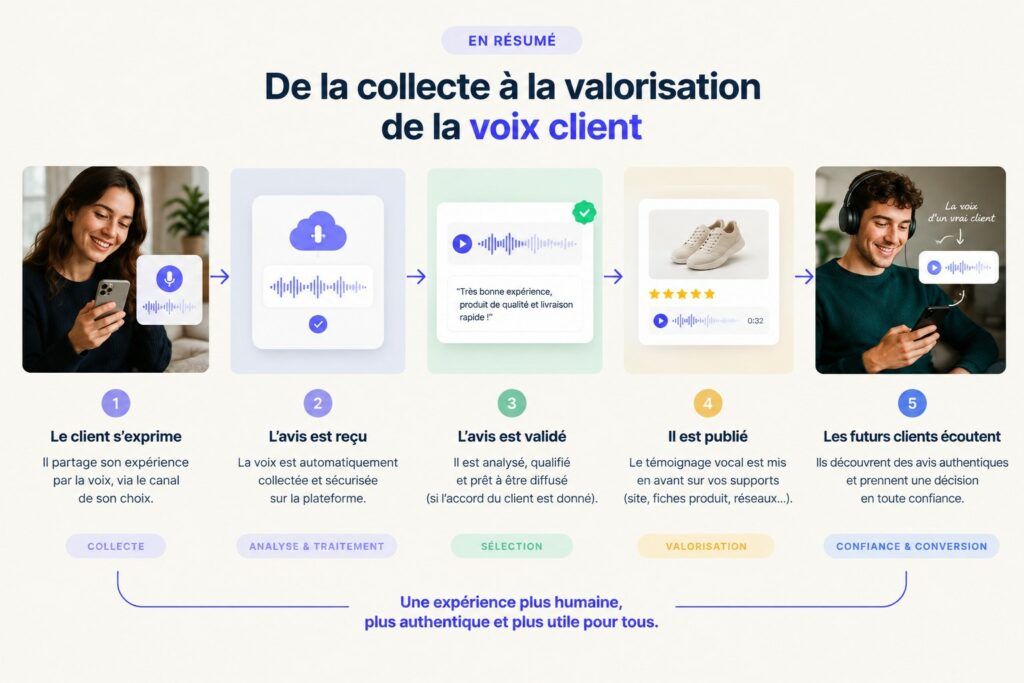
After making a purchase, the customer may be asked to share their experience, and—with their consent—their testimonial can then be used to influence future buyers.
We then move from collecting feedback to leveraging the voice of the customer.
What types of voice feedback should you collect?
It is not necessary to routinely ask the customer to describe their entire experience.
One good question can be enough.
Product Review
"What do you like most about this product?"
Returns After Purchase
"How was your experience?"
Satisfaction
"What could make your experience with us better?"
Product Review
"After using it for a few days, what do you think?"
Identification of Irritants
"Did you encounter any difficulties during your purchase?"
Customer Testimonial
"What would make you recommend this product to someone?"
The quality of the feedback depends largely on the question asked.
A question that is too general often yields a short answer.
A specific question encourages the customer to describe a concrete experience.
How Can You Analyze Voice Feedback Using AI?
Collecting feedback is the first step.
But when a company receives hundreds or thousands of testimonials, a new question arises:
How can we make the most of all these voices?
This is where artificial intelligence is a game-changer.
1. Transcribe the testimonies
Recordings can be automatically converted to text.
The voice can then be processed using standard analysis tools.
2. Group the responses by topic
AI can identify the topics that come up most often:
- delivery;
- product quality;
- price;
- use;
- customer service;
- in-store experience;
- packaging;
- features;
- satisfaction scores;
- irritants.
3. Identify trends
Instead of manually listening to several hundred testimonials, teams can identify recurring themes and then go back to the relevant audio recordings.
The voice remains the raw material.
AI makes it possible to use it on a large scale.
4. Preserve the original verbatim text
That's a key point.
A summary is helpful for understanding a trend.
But listening directly to the customer's voice allows us to reconnect with their experience, their words, and their tone.
That's what makes voice feedback so valuable.
Written reviews or voice feedback: Which should you choose?
No.
The two formats can be complementary.
Written communication remains the best option for a short, structured, and easily accessible response.
Voice can be particularly interesting when you're looking for more in-depth or personal feedback.
In fact, recent research suggests that voice should not be viewed as a one-size-fits-all solution. A study published in 2026 involving 1,001 respondents showed that the way voice input is integrated into a questionnaire strongly influences its use and the response rate. Systems that require voice input therefore do not necessarily produce better results.
The right approach is, rather, to offer a choice.
Let the customer write if they prefer to write.
And let him speak if he'd rather talk.
Carrefour: When Voice Technology Is Integrated into Customer Feedback Collection
Carrefour is a concrete example of this approach.
The goal was to better understand customer expectations and enhance satisfaction measurement, particularly with regard to the NPS.
With EKOO, the retailer has added the option to leave a voice review directly in its post-purchase emails.
The system was first tested in 230 hypermarkets before being rolled out across Carrefour's various store formats in France.
In just a few months, several thousand voice testimonials were collected. The system also allowed store managers to hear their customers’ feedback directly.
That's the main point:
Not just knowing how many customers are satisfied, but better understanding why.

The customer's voice is becoming a new source of data to be leveraged
Companies already have access to many sources of feedback: online reviews, surveys, NPS, conversations with customer service, social media, emails, and more…
So the issue is no longer just about collecting more data.
We need to collect the right data, in a format that allows the customer to express themselves easily.
This is also evident in the evolution of customer-generated content solutions. Platforms like JOIN, for example, use content produced by customers to enhance the e-commerce experience and complement written reviews with more immersive content.
Audio serves another purpose: to capture customer feedback directly and turn it into actionable insights.
And these two approaches can complement each other perfectly.
How do I set up voice feedback collection with EKOO?
With EKOO, you can integrate voice feedback collection directly into your customer journeys.
A post-purchase email.
A text message.
A QR code.
A product sheet.
A store tour.
The principle is simple: ask a question, let the customer answer using their own voice, and then make use of that material.
The platform allows you to collect audio testimonials and integrate them into the user journeys where they are most valuable.
This way, you get two things.
On the one hand, more in-depth customer feedback to help you better understand your customers.
On the other hand, authentic testimonials that can be used to your advantage with your future customers.
Because good feedback shouldn't just end up on a chart.
It should help improve the customer experience, drive the evolution of your products, and give your customers a real voice.
Would you like to try collecting voice reviews with EKOO? Request a demo.