

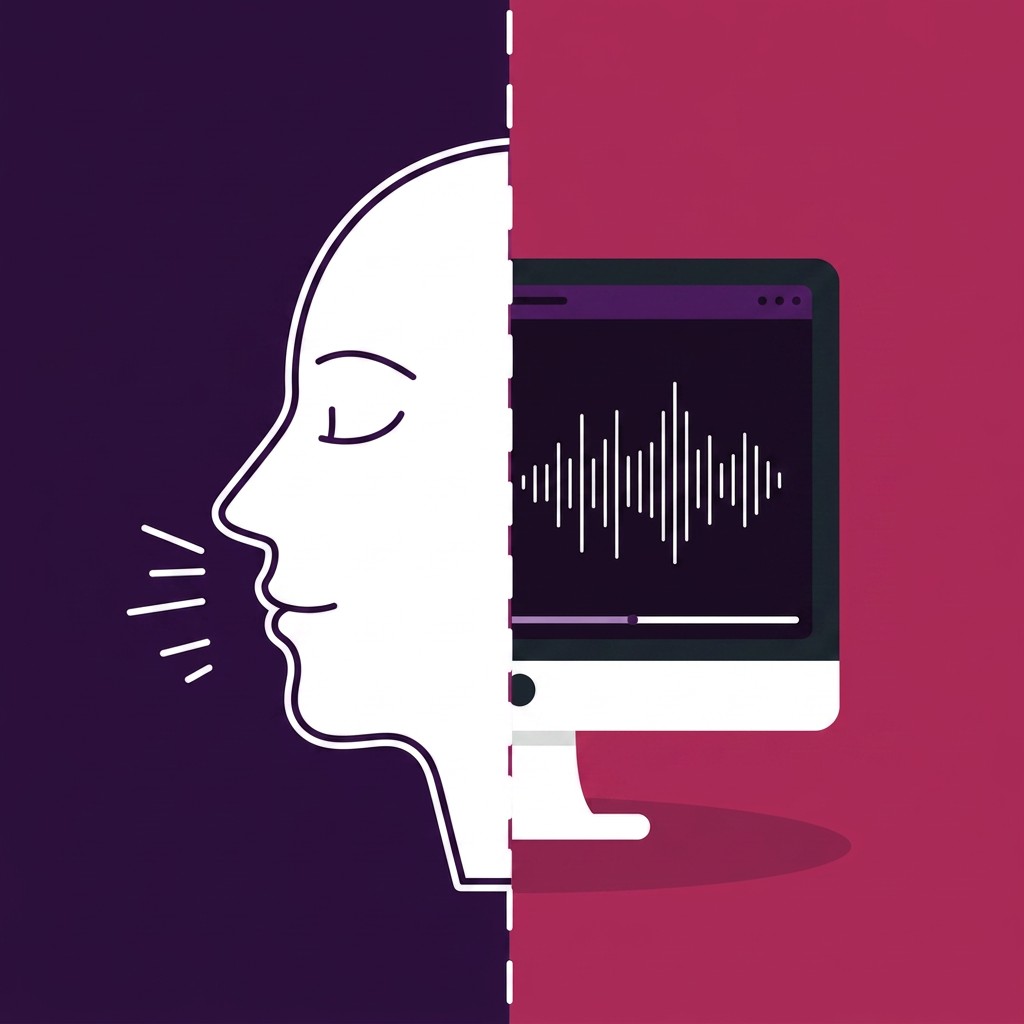
Text-to-speech: when AI brings text to life
For a long time, synthetic voices were mostly associated with robotic assistants with mechanical intonations. In 2026, they narrate books, respond to customers, and embody brands. According to Telnyx, 87% of consumers have already interacted with AI-based voice technology, a sign that audio is now establishing itself as a key driver of user experience and accessibility.
This development is based on text-to-speech (TTS), a technology capable of converting written text into natural-sounding speech. Thanks to AI, synthetic voices adapt to the text, rhythm, and intonation to sound more natural. They no longer simply read; they interpret. Text-to-speech is thus evolving toward increasingly natural applications.
Progress is rapid and tangible. Just a few minutes of recording are now enough to create a believable voice. Content is easy to update, distribution is multilingual, and audio production can be scaled up significantly. Domino’s is already using voice AI to handle some of its phone orders. BNP Paribas relies on Voxygen’s technologies to develop voice assistants aligned with its brand identity. In audio publishing, Spotify is also paving the way for more accessible audiobook production.
This democratization is driven by tools such as ElevenLabs, a leader in vocal realism and voice cloning, and Murf AI, which is geared more toward professional applications and corporate communications.
Human Voice vs. AI Voice: The Emotional Limits of Speech Synthesis
AI-generated voices are advancing rapidly, but the human voice still has an emotional edge. A study by the MPIEA shows that it is still considered more pleasant and engaging, with an average rating of 4.28 out of 5, compared to 3.45 out of 5 for synthetic voices.
However, the line is becoming blurred: 86% of listeners can recognize a human voice, compared to just 55% for an AI-generated voice. The realism is there. But conveying all the emotional subtleties of a human voice remains a challenge.
The realism is there. Now all that’s left is the emotion.
Voice Cloning and the Law: What You Can (and Can't) Do
Voice cloning makes it possible to reproduce a human voice using just a few seconds of audio. It preserves the timbre and intonations with a high degree of realism. A study by Queen Mary University of London shows that listeners perceive 58% of cloned voices as human, compared to 62% of real voices that they correctly identify.
These technologies now make it possible to generate full-length dialogues featuring multiple voices, paving the way for new applications in audio production and AI-generated voices.
But their development raises legal issues. Cloning a voice without consent may constitute an invasion of privacy. In Europe, AI-generated content must be identified as such. In January 2026, in Switzerland, a voice-cloning scam led to significant financial transfers before it was detected.
Voice cloning thus becomes a powerful but regulated technology.
AI-generated voices are gaining traction on social media
Voice is becoming a central feature of social media. This trend can be attributed to the growing use of AI-powered voice technology and text-to-speech on major platforms.
Instagram, TikTok, and LinkedIn are expanding their voice-based features—such as audio messages, voice notes, and AI-generated content—making interactions more direct and more personal.
Meta is taking it a step further: automatic translation of Reels, capable of dubbing a video while preserving the creator’s voice and tone.
YouTube is testing voice replies to comments to strengthen the connection between creators and their audiences.

In this environment, voice has emerged as a more human and effective tool for engagement than text alone, confirming the rise of AI voice and text-to-speech technology in digital applications.
As you may have noticed, AI-powered voices and text-to-speech are now becoming ubiquitous across all areas of the digital world. From speech synthesis to cloning, and everything in between—including music creation and social media—it is becoming both a production tool, a channel for expression, and a new interface for digital experiences. To better understand these transformations and their implications, Ekoo has compiled all the innovations, trends, and use cases related to audio and voice in its 2026 White Paper.