
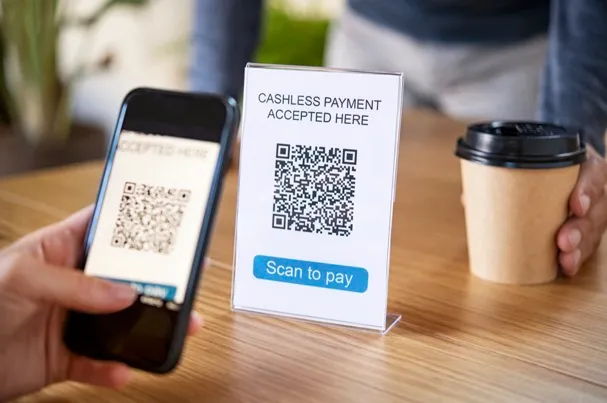
Since covid, we've seen an increase in the number of QR codes. This is obvious in the catering industry, but we're also seeing them on the Internet, in advertising, on products... and they've upset some of our consumer habits.
Thanks to their practicality, speed and playfulness, they were quickly adopted by consumers and businesses alike. Their ease of use, thanks to the integration of scanners in the cameras of new-generation smartphones, has had a significant impact on the explosion of their presence in everyday life.
But what are these strange barcodes, how do they work and what are they used for?

What are QR codes and how do they work?
The QR code is a two-dimensional barcode that can store a wide range of data. Once scanned, it quickly delivers information to the user, hence its name: Quick Response.
The first QR code appeared in 1994, from the Japanese company Denso Wave.
Today, they can be used to :
- Send and receive information
- Accessing wifi networks
- Link to a download
- Pay
To access the data contained in the QR code, simply target it with your smartphone's camera. The information will instantly appear on the screen, as most of today's smartphones are equipped with built-in scanners.
If this isn't the case, there are numerous applications available in the App Store and Google Play stores, such as I-nigma.

Scanning habits (and the impact of covid on these habits)
Today, around 1 in 5 French people use barcode or QR code scanning applications to obtain information on the products they consume. With the trend towards healthy and responsible consumption, these applications are becoming increasingly popular as they provide nutritional information and information on the origin of their purchases.
One of the most popular applications is called Yuka. With over 21 million downloads since its launch, and monthly use by 5.5 million users, it is the French leader in its field. Using various health and environmental criteria, it evaluates products in different categories such as food and cosmetics.

In a study conducted by MobileIron poll in Europe in 2020 on the use of QR codes, 72% of respondents had scanned one in the month prior to the study. What's more, 5 out of every 100 people use scanners on a regular basis when shopping, a figure set to rise sharply over the next few years. QR codes are therefore part of everyday life, but have not yet fully entered the consumer purchasing process.
In its native Japan, its use is much more widespread. In 2011, the average Japanese person already scanned 5 QR codes a day.
COVID, too, has come a long way and changed certain customs. Take the restaurant business, for example. Before the epidemic, very few restaurants used digital cards, visible through the use of a QR code. Since then, however, almost all establishments use them, and the number of physical cards has even fallen!
Another consumer habit that has grown strongly in recent years is self-scanning at automatic checkouts in supermarkets. Today, over 57% of hypermarkets and supermarkets are equipped with self-scanning checkouts. The French have embraced this innovation, and over 40% of consumers now use this tool on a regular basis.
How can a QR code benefit brands?
The advantage of the QR code is that it combines two methods: print (paper) and digital. By combining the two, companies can reach many more people.
QR codes make posters interactive. Instead of just knowing the information and images contained in the poster, viewers can immerse themselves in the subject through videos, animations, details... while still having a first look at the physical poster.
To evaluate the impact and success of an advertising campaign, we simply trace the code and analyze the usage statistics. We can then see the precise number of individuals who reacted to our content.
QR codes can also be used by brands for storytelling. In the textile industry, for example, by integrating a URL with the QR code containing information on the origin of the material, the manufacture or shipping of the products. Through anecdotes, brands can create a link with their audience, making it easier for them to identify with their products.
Storytelling is therefore a real asset to integrate into your marketing strategy, so that consumers can be guided by their emotions and become attached to you.
Examples of how QR codes can be used in marketing strategies

A good example of the use of QR codes in an advertising campaign is the Coca-Cola brand, with a design that integrates the QR code into the poster graphics. The advertisement will have a greater impact on its target audience, who will be interested and want to know more.
The gold medal for the most impressive use of QR codes undoubtedly goes to video game company Cyagames. In Shanghai in 2021, it used 1,500 drones to stage an aerial light show in the center of the city to promote its new game "Princess Connect: Re Dive".
The event culminated in the creation of a giant QR code in the sky using drones. When spectators scanned the QR code, they were redirected to the game's home page to download it and start playing.

In addition to advertising, QR codes can play a major role in the in-store experience. French organic cosmetics company Aroma Zone recently opened its eighth physical store in Toulouse. To simplify the customer journey and help them in their search, the brand has displayed a QR code on product labels, linking to detailed information and corresponding customer reviews. According to the sales team, around 30% of the store's customers use this tool to direct their search.
Things to remember
QR codes are appearing more and more frequently in the retail sector. They enable brands to communicate differently with customers. What's more, thanks to their ease of use on smartphones, they are much appreciated by their users. However, they are not yet a fully-fledged reflex in the customer journey, and can therefore be further exploited by brands, as there are still many possible uses.