

Voice search is no longer a trend. It has become a central interface between consumers, brands, and search engines.
According to a study published in October 2025 by Marketing LTB, an international agency specializing in data-driven marketing strategies, more than 50% of online searches are now conducted via voice assistants. The analysis, conducted by Bill Nash, CMO of the agency and digital performance expert, highlights a major shift: voice is transforming the way users search, compare, and make decisions.
By 2025, there will be 8.4 billion voice-enabled devices. Smartphones, connected speakers, cars, televisions... Voice is everywhere.
The question is therefore no longer "should we be interested in it?" but rather "how can we integrate voice search into our SEO and e-commerce strategy?"
For e-commerce and marketing directors, the challenge is clear: gain visibility on Google and in conversational engines (LLM), while improving conversion rates.
Why voice search is changing SEO
Voice search profoundly changes the structure of queries. They are longer, more natural, and often phrased as questions.

- 70% of voice searches use conversational language.
- Long-tail queries perform 2.5 times better.
- 75% of voice responses come from the top three Google results.
In other words: being visible is no longer enough. You have to be the answer.
Search engines favor clear, structured, educational content that provides immediate and understandable answers.
E-commerce: voice directly influences sales

Voice search isn't just an SEO issue. It's a business issue.
- 43% of users report making purchases via voice command.
- 58% use voice search to find a nearby store.
- 76% of local voice searches result in a same-day visit.
"Near me" searches have exploded in recent years. Voice reduces friction. It speeds up decision-making.
For brands, this means one thing: content must be designed to be listened to as well as read.
The LLM challenge: becoming a usable source
With the rise of conversational engines and generative AI, a new battle is being fought: that of content indexability and structuring.
LLMs rely on well-structured, conversational, contextualized content. Brands that anticipate this development are gaining a head start.
It's no longer just a question of keywords.
It's a question of semantic understanding.
Where does EKOO stand?
In this context, audio is not a gimmick. It is a strategic accelerator.
EKOO enables brands and retailers to transform their product and service expertise into structured, conversational, and indexable audio content.
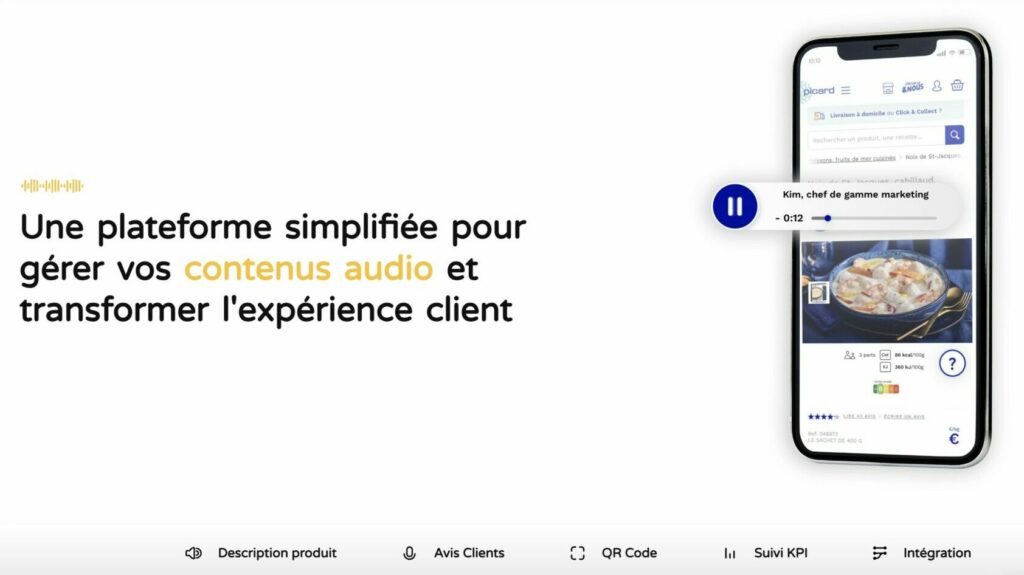
In concrete terms:
- Audio clips are transcribed and can be used by search engines.
- They improve time spent and reduce bounce rate
- They enrich product understanding
- They promote conversion
- They create a bridge between traditional SEO and conversational search.
Audio becomes an expert that never sleeps.
It answers questions from internet users, reassures them, explains things, and helps them make decisions.
Above all, it produces conversational content that is naturally aligned with voice usage and LLMs.
Conclusion
Voice search already accounts for 50% of global queries.
Within a few years, it will become dominant.
Engines are evolving. So are uses.
The real question for brands is no longer "should I produce content?"
But "is my content ready to be heard, understood, and picked up by conversational engines?"
This is where the next stage of SEO comes into play.