

Emotional voice AIs are shaking up the traditional codes of customer relations, paving the way for a more human experience.
Voice assistants don't just respond: they feel. Thanks to advances in artificial intelligence, some synthetic voices are now capable of detecting and simulating emotions, transforming the customer experience.
But how do these technologies work ? Why are they so popular in the customer service and e-commerce sectors? And what limits need to be set to guarantee a relationship of trust with the user?

Understanding emotional voice AI
From classic text-to-speech to simulated emotion
Emotional voice AI refers to a technology that generates a synthetic voice capable of expressing an emotion: joy, compassion, enthusiasm, depending on the context or tone detected in the interlocutor.
Where conventional voice synthesis produced neutral, mechanical and often impersonal voices, these new AI voices bring warmth and expressiveness to exchanges. An invaluable asset in customer interactions, where emotion strongly influences engagement, understanding and loyalty.
How does emotion detection work in AI?
These systems analyze the voice's paralinguistic cues: intonation, rhythm, pauses Thanks to spectral analysis and machine learning, the AI identifies the dominant emotion and adapts the voice accordingly, in real time.
Some AIs can even detect mixed emotions or evolve over the course of a conversation to refine their response.
Market-leading models
Several companies are already offering high-performance technologies in this field:
- Microsoft Azure Speech integrates an emotional dimension into its speech synthesis, adjusting intonation according to context.
- IBM Watson Tone Analyzer detects emotions in text and adapts the tone of messages.
- Hume AI goes a step further by modeling human emotions with great finesse.
- Beyond Verbal offers an emotional analysis based solely on voice.
These models can be used to generate an emotional AI voice capable of adjusting its style according to the situation, the audience, or the channel used.
Emotional voice AI: what are the benefits for customer relations?

More human communication on a large scale
In an age of automation, customers expect more authentic and empathetic exchanges. Emotional AI voice allows you to adapt your tone according to your needs: reassure, motivate, explain... while maintaining brand consistency.
The result : users feel better understood, which boosts their commitment and improves overall satisfaction.
Powerful leverage for customer service
In call centers or voice chatbots, these technologies can defuse tensions. An empathetic voice helps to calm a disgruntled customer, better manage emotions and redirect to a human agent if necessary.
It's an invaluable tool for streamlining exchanges and reducing the workload on human resources, while preserving the quality of the relationship.
Impact on e-commerce and digital journeys
Emotion is also a lever for conversion in the purchasing process. A well-modulated voice can enhance a product, reassure a customer or bring a user testimonial to life.
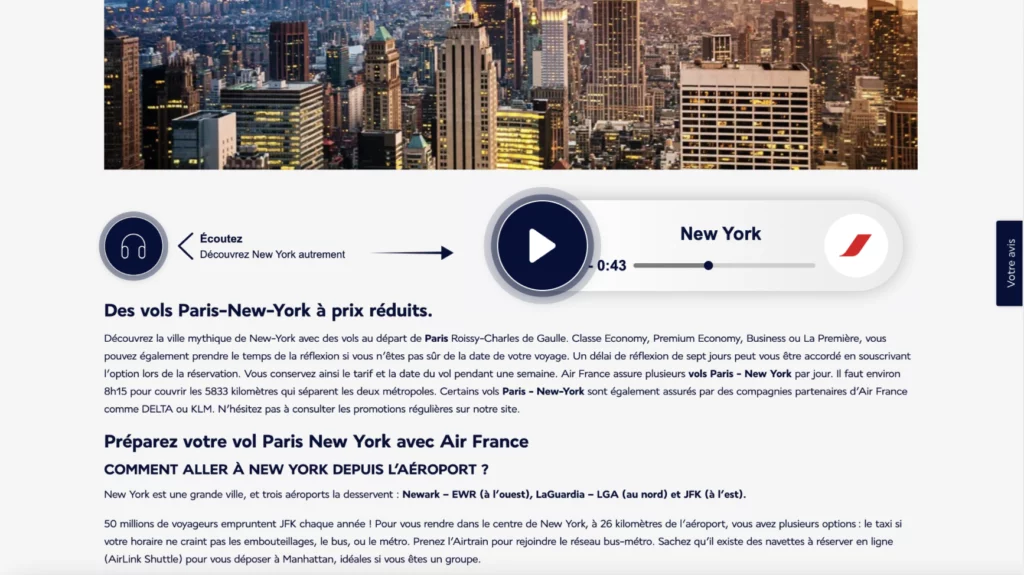
Example: EKOO x Air France

Air France uses EKOO's voice capsules on its destinations pages. Thanks to an emotional synthetic voice, advice is delivered in a reassuring, warm and expert tone, as if an Air France advisor were personally guiding you through your travels and destinations.
This removes disincentives to purchase,humanizes the digital journey and increases confidence in the product.
Limits and precautions
The illusion of emotion vs. real emotion
AI voices simulate emotions, but don't feel them. This imitation can work... but it can also create a feeling of unease if the user discovers it's a machine, especially if the voice is too "human".
This is theuncanny valley phenomenon: when realism becomes disturbing. It is therefore essential to maintain a certain degree of transparency to avoid any loss of trust.
Ethical issues

The rise of emotional AI voice also raises major ethical questions.
Should users be told that they are interacting with a synthetic voice? Should they be given the choice of whether or not to interact with a voice AI? And above all, how can we ensure that the voice data used to detect emotion is processed in compliance with the RGPD?
Transparency is key: the user must be informed not only of the nature of the technology, but also of the purpose of the emotional analysis. In some cases, such as customer service, the collection of emotional clues can be useful to improve the quality of the exchange. But it must be done within a clear framework of consent, with guarantees on confidentiality and the use of voice data.
Finally, there is the question of emotional manipulation: how far can we adapt a speech or tone to influence a decision (e.g. a purchase) without crossing ethical lines? This debate has already begun in the world of voice marketing.
The importance of people in the loop

AI should not replace humans, but complement them. It is useful for simple or repetitive interactions, but customer relations remain an area where listening, real empathy and nuance are irreplaceable.
The challenge is to build a balance where emotional AI enhances the experience, without erasing the relational value of the human.
Conclusion : emotional voice AIs are shaking up customer relations
Emotional voice AI is transforming customer relations, bringing a touch of humanity to automated exchanges. It enhances the user experience, reduces friction, and reinforces the credibility of digital interactions.
But like any powerful innovation, it needs to be used responsibly: transparently, ethically, and in a way that complements the human element.
What's next? AI voice could go even further, with emotional personalization on an individual customer scale.
Discover how EKOO uses the emotional voice to enrich the customer experience: